What to watch for
Most moles, freckles, and skin marks you have are entirely benign. They’ve probably been there for years and won’t cause any trouble. The skin lesions worth getting checked are those that have changed, or that have features that don’t fit the usual pattern.
The general principle: get checked anything that’s changing. Even if it turns out to be benign (which it usually will), an expert eye settles the question.
~16,000
new cases of melanoma diagnosed in the UK each year. Caught early it’s highly treatable; caught late it’s life-threatening. Most concerning lesions turn out to be benign — but checking is what matters.
The ABCDE rule
A widely used framework for assessing a mole. If a mole shows any of these features, get it checked:
- A — Asymmetry: one half doesn’t match the other
- B — Border: irregular, ragged, notched, or blurred edges
- C — Colour: uneven colour, multiple shades, dark spots within the mole
- D — Diameter: larger than 6mm (about the size of a pencil eraser) — though smaller melanomas can occur
- E — Evolving: changing in size, shape, colour, height, or starting to bleed, itch, or crust
Of these, E (evolving) is the single most important. A mole that was stable for years and has now started changing deserves prompt assessment.
The "Ugly Duckling" sign
Beyond ABCDE, look at your moles overall. Most of a person’s moles tend to look similar to each other. A mole that looks distinctly different from the others — an "ugly duckling" — is worth getting checked, even if it doesn’t individually meet ABCDE criteria.
Common benign lesions
Many skin marks people worry about turn out to be entirely harmless:
Seborrhoeic keratoses
"Stuck on" looking warty growths, often brown or black, particularly common from 40s onwards. Completely benign but can mimic melanoma to the untrained eye. Removed easily if cosmetically bothersome.
Skin tags
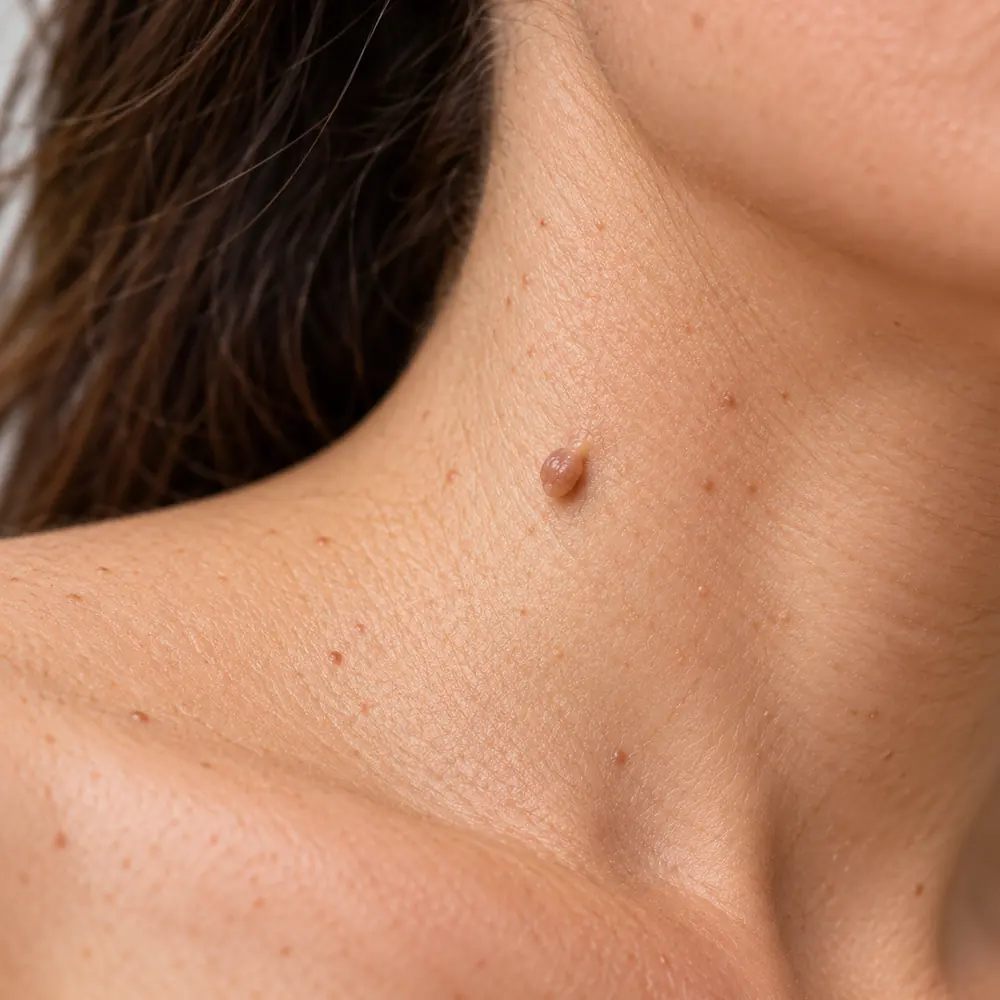
Soft, often flesh-coloured projections from the skin, particularly in skin folds (neck, armpits, groin). Harmless. Can be removed if irritating.
Cherry angiomas
Bright red small dots, particularly on the trunk. Increase with age. Benign.
Solar lentigos
"Age spots" or "liver spots" — flat, brown patches on sun-exposed skin. Benign but a marker of significant sun exposure.
Dermatofibromas
Small, firm bumps, often on the legs, that dimple when pinched. Benign.
Sebaceous cysts
Soft, often slow-growing lumps under the skin. Benign but sometimes become infected and need treatment.
Lipomas
Soft, mobile fatty lumps under the skin. Benign.
Common moles (nevi)
Most adults have 10–40 moles. They’re usually uniformly coloured, round or oval, smaller than 6mm, and stable over time. Most don’t turn into anything serious.
Skin cancer types
The three main types of skin cancer:
Melanoma
The most serious. Can arise from existing moles or as new lesions. Spreads if untreated, but highly curable if caught early. The ABCDE features above describe melanoma. Risk factors: fair skin, history of sunburns (especially in childhood), many moles, family history, immunosuppression.
Basal cell carcinoma (BCC)
The most common skin cancer overall. Slow-growing, locally destructive, but very rarely spreads beyond the skin. Often appears as a pearly nodule or non-healing sore. Almost always curable with appropriate treatment.
Squamous cell carcinoma (SCC)
Less common than BCC, more likely to spread if not treated. Often appears as a scaly, crusted, sometimes ulcerated lesion on sun-exposed skin. Curable with appropriate treatment but more urgent than BCC.
Actinic keratoses (pre-cancerous)
Rough, scaly patches on sun-exposed skin in older patients. Some progress to SCC over time. Treatable with various methods.
Risk factors
- UV exposure — both lifetime cumulative (working outdoors) and intermittent intense (childhood sunburns, holiday burning)
- Sunbed use — significantly increases melanoma risk, particularly under age 35
- Fair skin, light eyes, red/blonde hair
- Many moles (50+) or atypical moles
- Family history of melanoma
- Personal history of skin cancer
- Immunosuppression — transplant patients, certain medications
- Age — risk increases with age for most skin cancers
- Outdoor occupations — particularly without consistent sun protection
How we assess at the clinic
1. Clinical examination
Looking at the lesion of concern carefully and, if you have many moles or wish, performing a full skin examination. A chaperone is offered and standard for full skin examinations — see our Chaperone Policy.
2. Dermoscopy
A dermoscope is a hand-held device with magnification and polarised light that shows features of moles invisible to the naked eye. It significantly improves accuracy of clinical diagnosis. Painless, takes a minute or two per lesion.
3. Photographic documentation
For moles that look benign but you want to monitor, we can photograph them for comparison at a future appointment. This is helpful for people with many moles.
4. Decision
Based on examination, dermoscopy, and your history, we either:
- Reassure — the most common outcome. Benign features clear. Photograph for future comparison if useful.
- Watch and review — some lesions warrant follow-up in 3–6 months
- Remove for histology — for lesions with concerning features. Minor procedure under local anaesthetic. Tissue sent for pathology examination.
- Urgent specialist referral — for lesions suspicious of melanoma, we refer same-day to specialist dermatology under the NICE NG12 2-week wait pathway (or equivalent private referral). Time matters.
Treatment options
Treatment depends on what the lesion is and where it is.
For benign lesions
- No treatment needed unless cosmetically bothersome or causing symptoms
- Cryotherapy (freezing) for some lesions including seborrhoeic keratoses and skin tags
- Curettage and cautery for skin tags, seborrhoeic keratoses
- Surgical excision for cysts, lipomas, larger lesions
For suspicious lesions
- Excisional biopsy — complete removal with a margin of normal skin, sent for histology
- Punch biopsy — small sample, occasionally appropriate
For confirmed skin cancer
Treatment depends on type, size, and location. Most BCCs are treated with surgical excision; some respond to creams or photodynamic therapy. Melanoma requires specialist surgical management and sometimes additional treatment. We coordinate referrals to dermatology and plastic surgery as needed.
Prevention and sun safety
Most skin cancers are largely preventable. Key measures:
- Avoid sunburn — particularly in childhood; sunburns in childhood are the strongest predictor of melanoma in later life
- Sunscreen — SPF 30 or higher, broad-spectrum, applied generously, reapplied every 2 hours and after swimming. Most people apply far too little.
- Shade and clothing — the most effective sun protection; wide-brimmed hats, UV-protective clothing
- Avoid peak UV hours — 11am to 3pm in summer
- Avoid sunbeds — particularly under age 35
- Self-examination — check your skin monthly. Use a mirror or partner for hard-to-see areas. Note changes.
- Periodic professional skin check — particularly if you have multiple risk factors
When to see us
Book an appointment if:
- A mole has changed (size, shape, colour, height)
- A mole has new symptoms (itching, bleeding, crusting)
- You have a new dark spot you don’t remember
- You have a "different-looking" mole among others
- You have a non-healing sore that won’t go away
- You have multiple risk factors and want a baseline skin check
- You have a family history of melanoma
- You’ve been told a lesion needs removal but want it done sooner than NHS waits allow
Frequently asked questions
What does the appointment involve?
A focused 15–20 minute appointment for one lesion, or 30 minutes for a full skin check. We examine, use dermoscopy, discuss what we see, and either reassure, monitor, or arrange removal.
Will I have it removed at the appointment?
Not usually. If the lesion needs removal, this is arranged as a separate minor surgery appointment within a week or two. If it’s suspected to be melanoma, we refer urgently rather than removing it ourselves.
Will it leave a scar?
All surgical removal leaves some mark. We use careful technique to minimise scarring; cosmetic outcome is generally good but no removal is scarless.
How much does it cost?
Consultation cost is on our Fees page. Removal procedures are quoted separately depending on size, location, and complexity. Histology (laboratory examination of removed tissue) is included where indicated.
What if you find melanoma?
Urgent specialist referral, usually within days. We follow you up to make sure the referral is being acted on. Early-stage melanoma is highly curable with prompt surgical management.
Should I have all my moles photographed?
Total body photography is reasonable if you have many moles or atypical moles, multiple risk factors, or strong family history. We can discuss whether this fits you.
Does insurance cover skin lesion removal?
We welcome patients with private medical insurance, but we currently operate on a self-pay basis and do not yet offer direct billing with Bupa or other private medical insurers. Our applications for insurer recognition have been submitted and are awaiting approval. You are welcome to book and pay directly, and you may wish to ask your insurer whether you can claim reimbursement under your policy. Insurance reimbursement cannot be guaranteed. See our private medical insurance page.
What about wider issues like eczema, acne, rosacea?
These are general dermatology rather than skin lesion concerns — see our dermatology page or book a private GP appointment for assessment and treatment.