
Eye · Flashes, floaters and retinal detachment · Private clinic in East London
Flashes and floaters: when to get help in East London.
Floaters are extremely common and usually nothing more than the jelly inside the eye becoming more liquid with age. But a sudden change in floaters or flashes can mean the retina is tearing — and a tear caught early is treated in minutes, while a detachment left late may cost permanent sight. If you notice a sudden shower of new floaters, flashing lights or a curtain or shadow over your vision, go to an eye casualty (A&E) the same day. For non-urgent concerns, consultant ophthalmologist Dr Filis Ayan sees patients at our clinic in Whitechapel, East London, without a GP referral — see our eye clinic.
Consultation with Dr Ayan £195
- Consultant ophthalmologist
- No GP referral needed
- Adults & children
- Whitechapel, E1

 Dr Filis AyanConsultant Ophthalmologist · PhD, FEBO
- Consultant-led careGMC Specialist Register
- PhD in OphthalmologyUCL Institute of Ophthalmology
- Adults & childrenNo GP referral needed
- Whitechapel, E1Open 7 days, 9am–7pm
Book onlineChoose a time in a few taps. Booking opens right here on our website.
Payment information: We currently operate on a self-pay basis and do not offer direct billing with Bupa or other private medical insurers. Insurance information
The condition
What is flashes, floaters and retinal detachment?
Floaters are extremely common and usually nothing more than the jelly inside the eye becoming more liquid with age. But a sudden change in floaters or flashes can mean the retina is tearing — and a tear caught early is treated in minutes, while a detachment left late may cost permanent sight.
- What flashes, floaters and retinal detachment is
- Symptoms to look for
- Causes & risk factors
- Tests & diagnosis
- Treatment options
- When to see a specialist

Understanding flashes, floaters and retinal detachment
Flashes, floaters and retinal detachment: symptoms, causes, tests & treatment
Written for patients by our clinical team. If anything here sounds like you, book a consultation with Dr Ayan.
Seek emergency eye assessment the same day if you have
- a sudden shower of new floaters, particularly many at once
- flashes of light, especially in the peripheral vision or in the dark
- a dark curtain, shadow or veil spreading across your vision
- a sudden loss of part of your field of vision
- sudden blurring of central vision, or straight lines appearing bent
- these symptoms after an eye injury or head injury
A retinal tear treated with laser before the retina detaches is a straightforward outpatient procedure. Once the retina detaches, surgery is required and the visual result depends heavily on whether the central vision was involved and for how long. This is measured in hours and days, not weeks. Moorfields Eye Hospital runs a 24-hour walk-in emergency eye service; the nearest emergency department is the Royal London Hospital, Whitechapel Road, London E1 1FR.
The common, harmless kind
Small specks, threads or cobwebs drifting across your vision, most noticeable against a bright plain background such as the sky or a white wall, moving as your eye moves and drifting on when it stops. These are shadows cast by strands in the vitreous jelly. They are extremely common from middle age onwards, tend to become less noticeable over months as the brain filters them out, and need no treatment.
What changes the picture
- Sudden onset rather than gradual
- Many new floaters at once, sometimes described as soot, smoke or a swarm of flies
- Flashes — brief arcs or streaks of light, typically at the edge of vision and worse in the dark
- Any loss of visual field, however small, or a shadow that is not moving with your eye
Posterior vitreous detachment
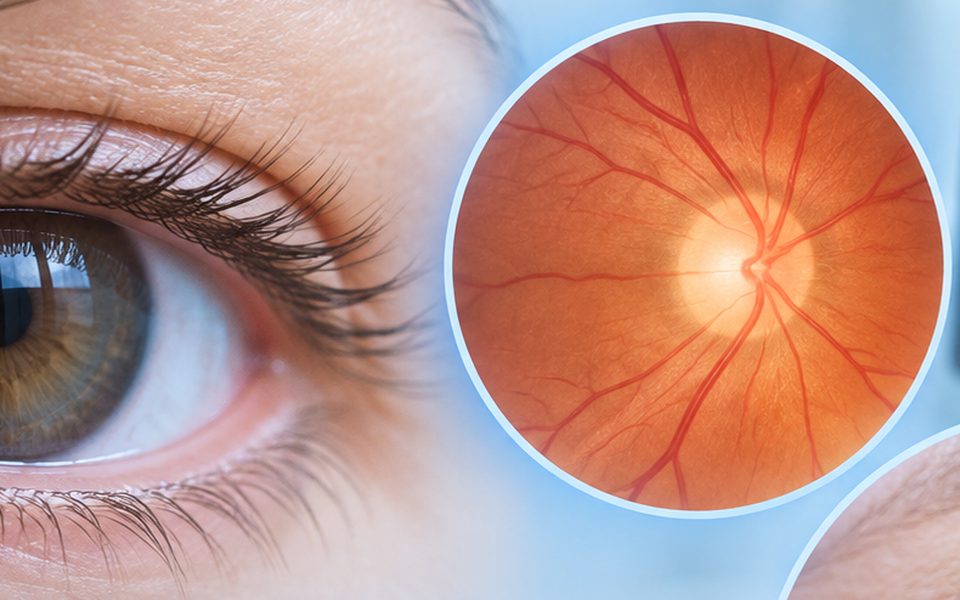
The commonest cause of sudden new floaters and flashes is the jelly peeling away from the retina — a normal ageing change affecting most people eventually. It is usually harmless. However, in a small proportion the jelly tears the retina as it separates, and there is no way to tell the difference without a dilated examination of the retina. That is why sudden new floaters and flashes always warrant an examination, even though most turn out to be fine.
Who is at higher risk
- Short-sightedness, particularly strong prescriptions — the commonest risk factor
- age over 50
- previous cataract surgery or other eye surgery
- a previous retinal tear or detachment, in either eye
- a family history of retinal detachment
- eye injury, and some inherited eye conditions
What examination involves
Drops are used to dilate the pupil, and the retina is examined in detail. Vision is blurred and light-sensitive for several hours afterwards, so you should not drive and should bring sunglasses. If a tear is found, laser or freezing treatment seals it, usually the same day and usually preventing detachment altogether.
Do not sit on new flashes or floaters. If your vision is affected or a shadow is spreading, go straight to an emergency eye service — that is faster than any appointment. But if you have new floaters without visual loss and want to be seen properly rather than wait, we can assess you the same day, 7 days a week, examine the eye, exclude the causes that need urgent referral, and arrange same-day ophthalmology where the retina needs a dilated examination. No referral is needed and we are open 9am–7pm.

Meet your eye specialist
Dr Filis Ayan
Consultant Ophthalmologist
Dr Filis Ayan is a consultant ophthalmologist on the GMC Specialist Register (GMC 7346842). She holds a PhD in ophthalmology from the UCL Institute of Ophthalmology, is a Fellow of the European Board of Ophthalmology, and worked as an Honorary Clinical Research Fellow in Medical Retina at Moorfields Eye Hospital and the Royal Surrey County Hospital.
- Consultant Ophthalmologist
- PhD, UCL
- FEBO
- English · Turkish · Bulgarian
- Eyelid surgery & blepharoplasty
- Chalazion & eyelid lesions
- Dry eye & blepharitis
- Watery eyes & tear ducts
- Uveitis & red eye
- Children’s myopia management
- Medical retina & eye injections
Your patient journey
Seen, examined, explained.
Most eye problems are assessed and diagnosed in a single consultation. If a procedure is needed, it is planned with you before you leave.

- 01
Book online or call
Book a consultant eye consultation online or call 020 7916 0029. No GP referral needed.
- 02
History & examination
Dr Ayan asks about your symptoms and examines your eyelids and eyes, usually with a slit lamp.
- 03
Diagnosis & plan
You get a clear explanation and a written plan: treatment, a procedure, monitoring or further tests.
- 04
Treatment or onward care
Minor procedures are booked at the clinic. Scans and pressure tests are arranged with a local optometrist, and anything else we don’t provide is referred on with a letter.
Consultation & pricing
Private consultations & prices.
Consultant-led eye care with clear, published prices and no GP referral needed. “From” prices depend on what you need, and your exact fee is confirmed with you before any test, procedure or treatment goes ahead.
Payment information: We currently operate on a self-pay basis and do not offer direct billing with Bupa or other private medical insurers. Insurance information · Full price list
Frequently asked questions
Flashes, floaters and retinal detachment in London: your questions answered
Quick answers about appointments, treatments and eye care at Tower Bridge Hospital London.
Where can I find a private flashes, floaters and retinal detachment specialist near me in East London?
Our private eye clinic is on Whitechapel Road in East London, minutes from Canary Wharf and the City. You can see our consultant ophthalmologist, Dr Filis Ayan, for an assessment without a GP referral.
Can I see a private eye specialist for flashes, floaters and retinal detachment the same day?
Same-day appointments with one of our doctors are often available, including Saturdays. Appointments with our consultant ophthalmologist, Dr Filis Ayan, are on her clinic days and can be booked online.
How much does a private flashes, floaters and retinal detachment appointment cost in London?
A consultation with our consultant ophthalmologist, Dr Filis Ayan, is £195. See our fees page or call 020 7916 0029.
Do I need a referral to see a private eye specialist for flashes, floaters and retinal detachment?
No. You can book directly with our clinic. If you are unsure whether to start with a private GP or an eye specialist, we will guide you.
Which areas do you serve for private flashes, floaters and retinal detachment care?
We see private patients from across East London, Canary Wharf, the City of London, Docklands, Aldgate, Wapping, Limehouse and Tower Hamlets.
Private eye clinic London
See a private eye specialist for flashes, floaters and retinal detachment in London
At our private eye clinic on Whitechapel Road in East London, you can see a private eye specialist or flashes, floaters and retinal detachment doctor without a GP referral. A private GP in East London or consultant eye specialist will assess you, arrange the right tests and explain your diagnosis and treatment options clearly. We help patients across East London, Canary Wharf, the City, Docklands and Aldgate who want fast, private answers about flashes, floaters and retinal detachment.
Tower Bridge Hospital is on Whitechapel Road in the heart of East London — minutes from Canary Wharf, the City of London, Docklands and Aldgate. Patients across Tower Hamlets, Wapping, Limehouse and Bethnal Green choose us for a private flashes, floaters and retinal detachment appointment with an eye specialist, without a GP referral.
Medically reviewed by Dr Haydar Bolat — Clinical Director, GMC 7138332. Last reviewed August 2026 · next review August 2027. Written in line with our editorial & content-review policy, using guidance from the NHS, NICE and the relevant royal colleges. This information is general and does not replace personal medical advice.
More eye care
Explore our eye services.
All eye appointments are with the same consultant ophthalmologist at our Whitechapel clinic.
 Eyelids
Eyelid surgery (blepharoplasty)
Heavy or hooded upper lids, lower-lid bags, brow lift and eyelid position problems.
 Eyelid lumps
Chalazion & eyelid lumps
Eyelid cysts, styes that won’t settle, skin tags, papillomas and ingrowing lashes.
 Ocular surface
Dry eye & blepharitis
Gritty, burning or tired eyes, sore eyelid margins and punctal plugs.
 Tear ducts
Watery eyes & tear ducts
Constant watering, blocked tear ducts, syringing, probing and punctoplasty.
 Retina
Eye injections for macular disease
Wet AMD, diabetic macular oedema and retinal vein occlusion, treated with injections in clinic.
 Inflammation
Red eye & uveitis
Painful red eye, uveitis, episcleritis, scleritis, keratitis and allergic eye disease.
 Children
’s myopia management
Slowing short-sightedness in children, with regular specialist reviews.


Ready to take the next step?
Your eyes, in expert hands.
Book a private consultation with consultant ophthalmologist Dr Filis Ayan. No GP referral needed.