Not an emergency service. In an emergency call 999.
WelcomeThis page is available in over 100 languages.
Skin lesion removal · Whitechapel, London
Skin Lesion Removal in London
Private removal of benign skin growths — seborrhoeic keratoses, dermatofibromas, fibroepithelial polyps and other harmless lesions — under local anaesthetic at our Whitechapel clinic. Dermoscopy first, the right technique for the site, and histology where clinically indicated. A £150 assessment comes first.
Most lumps and marks that appear on adult skin are harmless. The ones we are most often asked to remove are:
Seborrhoeic keratoses — waxy, warty, “stuck-on” brown or skin-coloured growths that multiply with age, common on the trunk, face and scalp.
Dermatofibromas — small firm nodules, often on the legs, that dimple when pinched.
Fibroepithelial polyps — larger, fleshy versions of a skin tag, usually in areas of friction.
Other benign growths — assessed individually, including lesions where a diagnosis is needed before deciding on removal.
Moles, cysts, lipomas, skin tags, milia and warts each have their own page; this page covers the benign growths that do not fit those groups. Because some skin cancers can resemble a keratosis, every pigmented or changing lesion is examined with dermoscopy before removal is agreed.
When removal might be considered
Benign lesions do not need removing for medical reasons. People choose removal because a growth catches on clothing or jewellery, itches or bleeds when knocked, is visible on the face or neck, or simply because they want it gone. Removal is also appropriate when the diagnosis is uncertain and the lesion is best examined under the microscope.
Assessment first
At your £150 assessment the clinician examines the lesion with dermoscopy, confirms it is benign or decides it needs a biopsy, and agrees the technique, expected cosmetic result and price. Lesions with any suspicious features are managed through dermatology and, where needed, the appropriate specialist or NHS urgent pathway — they are never simply removed for cosmetic reasons. Facial and eyelid-margin lesions may be planned with our Consultant Plastic Surgeon.
How the procedure works
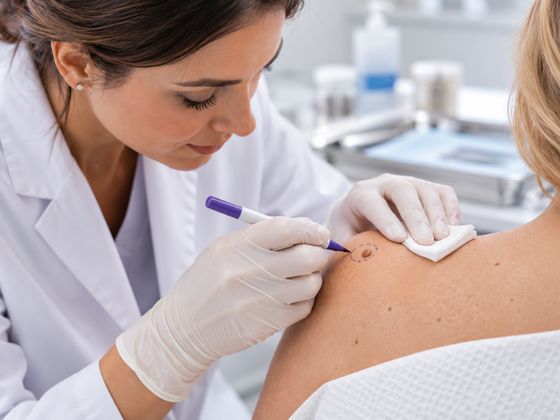
Under local anaesthetic, the lesion is removed using the technique agreed at assessment. Superficial growths such as seborrhoeic keratoses are usually shaved level with the surrounding skin or treated with curettage and light cautery, leaving a small raw area that heals in one to two weeks with a dressing. Firmer lesions such as dermatofibromas are excised as a small ellipse and closed with sutures. Most sessions take 15–40 minutes, and several lesions can often be treated together.
Techniques available
Shave excision — for raised superficial lesions; no stitches, heals as a flat pale mark.
Curettage & cautery — the lesion is scraped away and the base sealed; suits keratoses and small polyps.
Cryotherapy (freezing) — liquid nitrogen for selected thin lesions; may leave a lighter patch on darker skin.
Elliptical excision — full-thickness removal with sutures for firm or deeper lesions, or where histology of the whole lesion is wanted.
Scarring & cosmetic considerations
Every technique that breaks the skin leaves some mark. Shave and curettage sites usually fade to a small flat area slightly paler than the surrounding skin; excision leaves a fine line roughly three times the width of the lesion, which softens over 6–12 months. Skin type, site and sun exposure all influence the result, and your clinician will explain what to expect for your lesion before you decide.
Benign skin lesion removal — excision with suturesQuoted after assessment
Histology (per specimen, where indicated)£120
The £150 assessment is charged separately and comes first. Procedure pricing depends on the size, number and site of lesions and the technique used; single benign lesions start from £295 per session. See the full fee list.
Histology & laboratory testing
Excised tissue is sent to an accredited laboratory for histology where clinically indicated, with a low threshold for testing any lesion whose diagnosis is not certain and for lesions removed by full excision. Clearly benign superficial growths removed for cosmetic reasons are not routinely tested. Histology is charged separately, and your clinician will tell you before treatment whether your specimen is being sent.
Recovery & aftercare
Keep the area clean and dry for 24–48 hours, then follow the dressing advice you are given. Shave and curettage sites scab and heal over one to two weeks; sutured excisions have their stitches removed at 7–14 days depending on the site. Most people return to desk work the same or next day. See our minor surgery recovery guide for detail and red flags.
Risks & limitations
Minor surgery is safe but not risk-free. Possible issues include bleeding, infection, a scar that is more noticeable than hoped, a change in skin colour at the site, incomplete removal or regrowth of a superficial lesion, and — rarely — an unexpected histology result requiring further treatment. All are discussed at assessment and covered in your written consent.
Procedure at a glance
Pricefrom £295 per session
Assessment fee£150 (first)
AnaestheticLocal
Procedure time15–40 min
HistologyWhere clinically indicated
RecoveryDesk work next day; 1–2 wks to heal
LocationWhitechapel, E1
Who performs your procedure
Benign skin lesion removal at Tower Bridge Hospital is matched to the right clinician: our Consultant Plastic Surgeon for excisions and cosmetically sensitive sites, a minor-surgery doctor for straightforward superficial lesions, and our Consultant Dermatologist, Dr Elena Koleva, for medical assessment and diagnosis where a lesion needs a diagnosis first (she does not perform surgery).
Consultant Plastic Surgeon
Dr Yıldırım Özdoğan
Consultant Plastic Surgeon on the GMC Specialist Register. Performs minor surgical procedures at Tower Bridge Hospital, including excisions, larger lipomas and cysts, cosmetically sensitive sites and repair procedures.
GP with Special Interest in ENT (MBBS, MRCGP, GPwSI ENT). Performs minor surgical procedures at Tower Bridge Hospital, with the clinician selected according to the procedure, anatomical site and complexity.
Skin lesion removal in London — Whitechapel, the City & East London
Looking for seborrhoeic keratosis or benign skin lesion removal near you? Our Whitechapel clinic is a few minutes’ walk from Whitechapel and Aldgate East stations and one Elizabeth line stop from Liverpool Street and Canary Wharf.
Tower Bridge Hospital London is at 97–99 Whitechapel Road, E1 1DT. We regularly see patients for skin lesion removal from:
WhitechapelAldgate EastCity of LondonLiverpool StreetShoreditchBethnal GreenCanary WharfMile EndBowStratfordLondon BridgeBermondseyEast London
Frequently asked questions
What is a seborrhoeic keratosis and does it need removing?
A seborrhoeic keratosis is a common, harmless, waxy or warty raised growth that appears with age, often brown or skin-coloured and looking “stuck on”. It never turns into cancer and does not need removing for medical reasons, but many people choose removal because it catches, itches, or is visible. Any lesion that is new, changing, dark or irregular is assessed with dermoscopy first, because some skin cancers can mimic a keratosis.
How is a benign skin lesion removed?
Depending on the lesion: shave excision (the growth is shaved level with the skin under local anaesthetic, no stitches), curettage and cautery, cryotherapy (freezing) for suitable superficial lesions, or a full elliptical excision with sutures for firmer lesions such as dermatofibromas. Your clinician recommends the technique that gives the best balance of complete removal and cosmetic result.
Will skin lesion removal leave a scar?
Shave removal and curettage usually heal to a small flat pale or pink mark that fades over months. Excision leaves a fine line scar. Cryotherapy can leave a lighter patch, particularly on darker skin, which is why we choose the method carefully for the site and skin type.
How much does skin lesion removal cost in London?
A £150 assessment comes first. The procedure price depends on the size, number and site of lesions and the technique used, and is confirmed after assessment — single benign lesions start from £295 per session. Histology, where indicated, is £120 per specimen.
Is the tissue sent to the laboratory?
Where the diagnosis is clinically certain and the lesion is clearly benign, routine testing is not needed. Where there is any diagnostic doubt — or the lesion is removed by full excision — we have a low threshold for sending it for histology and will tell you before treatment.
Can several lesions be removed in one visit?
Often, yes. Multiple seborrhoeic keratoses or small polyps can usually be treated at the same session. Your clinician confirms the plan and total price at assessment.
What is a dermatofibroma?
A firm, small, often slightly dark nodule in the skin, most common on the legs, which dimples when pinched. It is benign and does not need treatment unless it is symptomatic or bothersome, when it can be excised with a small ellipse and sutures.
Do I need a GP referral?
No. Book a £150 assessment directly. If a lesion needs specialist dermatology or an NHS urgent skin-cancer pathway, we will tell you and refer you.
Medically reviewed by Dr Yıldırım Özdoğan, Consultant Plastic Surgeon (GMC Specialist Register), Tower Bridge Hospital London. Information on this page is for general guidance and does not replace individual clinical assessment. Sources: NICE, NHS and the British Association of Dermatologists.
Explore other procedures
More surgical procedures.
Minor surgery and day procedures at our Whitechapel hospital — each assessed first, with the price confirmed before treatment.
In an emergency, call 999. Tower Bridge Hospital London is not an emergency service. Your nearest A&E is The Royal London Hospital, Whitechapel Road E1 1FR — 5 minutes’ walk from our front door.
Skin Lesion Removal in London & East London — Whitechapel, the City & Canary Wharf
Our Cyst Removal (Sebaceous & Epidermoid) service at Whitechapel, E1 cares for patients from right across London and East London, the City and the Docklands — including Aldgate, Bethnal Green, Bow, Shoreditch, Canary Wharf, Stratford, Bermondsey and the surrounding areas. Same-day assessment appointments are often available, selected simple procedures may be performed at the same visit where clinically appropriate, and you do not need a GP referral.
Whitechapel E1
Aldgate E1
Stepney E1
Shadwell E1
Wapping E1W
Bethnal Green E2
Mile End E1
Bow E3
Poplar E14
Limehouse E14
Canary Wharf E14
Isle of Dogs E14
Shoreditch EC2
Hoxton N1
Dalston E8
Hackney E9
Stratford E15
Canning Town E16
City of London EC2
Liverpool Street EC2
Bank EC3
Old Street EC1
Clerkenwell EC1
Angel N1
London Bridge SE1
Bermondsey SE1
Borough SE1
Rotherhithe SE16
Easy to reach — minutes from the Royal London Hospital and Aldgate East, Whitechapel, Aldgate and Liverpool Street stations, and one stop from Canary Wharf on the Elizabeth line.
Looking for cyst removal (sebaceous & epidermoid) near me?
If you are searching for a private cyst removal (sebaceous & epidermoid) near me, a doctor, clinic or specialist near me in East London, our Whitechapel practice is on your doorstep — same-day assessment appointments, no GP referral, and no long NHS waiting list.
Private & self-pay
Insurance & self-pay welcome
No GP referral needed
Same-day & walk-in
Open 7 days a week
Turkish & English spoken
Welcoming new patients
Skip the NHS waiting list
Book online
For City & Canary Wharf professionals and East London families
Book a same-day appointment or call 020 7916 0029. See our transparent fees. Open 7 days a week, 9am–7pm. Private clinic on Whitechapel Road, London E1 — serving Tower Hamlets, Hackney, Newham, Islington, the City of London and Southwark.