

Prostatitis · Specialist Urologist · Whitechapel, London
Chronic Prostatitis Treatment in London
Private assessment for chronic prostatitis in Whitechapel, London with Specialist Urologist Dr Kishore Bahl — persistent prostate and pelvic discomfort, painful ejaculation and urinary symptoms. Persistent prostatitis-like symptoms are often not caused by infection, so assessment comes first and antibiotics are not automatic. No GP referral needed.
Specialist urology consultation £150


Educational information — not a substitute for clinical assessment
This page describes chronic prostatitis and its assessment in general terms to help you decide whether an assessment may be useful. It is not a diagnosis and does not promise a particular result. Suitability, the number of sessions and whether treatment is appropriate at all are decided at consultation. Outcomes vary between individuals and treatment is not suitable for everyone.
Why people come to us about this.
Prostatitis is one of the most frustrating conditions in urology — for patients and clinicians alike. Many men have been through several courses of antibiotics without improvement, because not all prostatitis is bacterial.
What this condition actually is.
Prostatitis describes inflammation of the prostate, but it covers several distinct conditions with different causes and treatments.
Acute bacterial prostatitis is an infection requiring prompt antibiotic treatment. Chronic bacterial prostatitis is a recurrent infection. Chronic non-bacterial prostatitis, also called chronic pelvic pain syndrome, is by far the commonest and involves no demonstrable infection.
Establishing which you have is the single most important step, because treating the wrong one gets nowhere. Focal shockwave is relevant to the non-bacterial form.
Book: Chronic prostatitis treatment in london
Specialist urology consultation — £150. With Dr Kishore Bahl, Specialist Urologist.
What you might be noticing.
- Pain in the perineum, lower abdomen, groin, testicles or lower back
- Pain or burning on passing urine
- Urinary frequency, urgency or difficulty starting
- Pain during or after ejaculation
- Erectile difficulty
- In acute infection: fever, chills and feeling systemically unwell — this needs urgent assessment
What tends to cause it.
- Bacterial infection, in acute and chronic bacterial prostatitis
- Pelvic floor muscle dysfunction and tension
- Neuropathic pain and central sensitisation in longstanding cases
- Inflammation without demonstrable infection
- Previous urinary tract infection or instrumentation
- Stress, which does not cause the condition but reliably worsens it
How treatment helps.
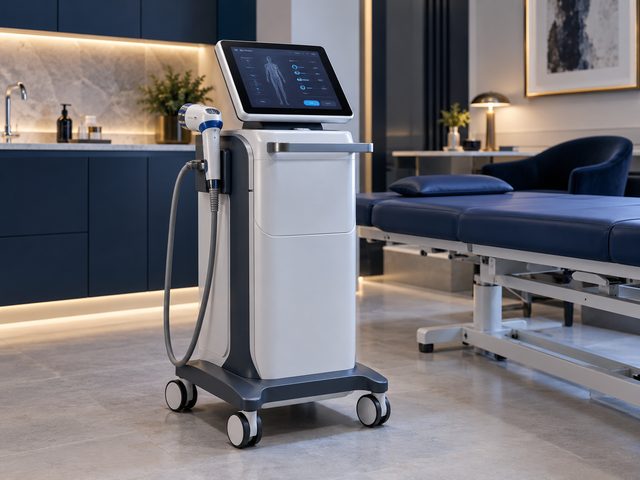
Focal shockwave has been studied in chronic non-bacterial prostatitis and chronic pelvic pain syndrome.
The intention is to reduce pain and improve local tissue conditions in the pelvic floor and perineum.
It does not treat bacterial infection. If infection is present, that is treated first.
It is used as part of a broader plan, which commonly includes pelvic floor physiotherapy.
Where focal shockwave may help.
We use focal shockwave because it delivers energy to a defined depth — up to approximately 12 cm — allowing accurate treatment of deeper structures. Radial devices spread energy outwards from the applicator and lose intensity quickly, which limits them to more superficial targets.
How we assess and manage chronic prostatitis.
Treatment follows assessment, not the other way around. Our approach works through, in order:
- Assessment — history, examination and urine testing, checking for infection where relevant.
- Phenotyping the problem — persistent prostatitis-like symptoms are frequently chronic non-bacterial prostatitis rather than an infection, so antibiotics are not automatically the answer. Chronic bacterial prostatitis does exist and is treated when it is actually found.
- Investigations where indicated — blood tests, imaging or further tests only if the picture calls for them.
- Multimodal management — tailored to your pattern: medication, pelvic-floor and lifestyle measures, pain management, and treatment of any confirmed infection.
- Focal shockwave where appropriate — one possible option for selected patients with persistent symptoms. Not a standard treatment for everyone.
Persistent prostate and pelvic symptoms overlap closely with chronic pelvic pain syndrome (CPPS), and the two are assessed together. Your care is led by Dr Kishore Bahl, Specialist Urologist. This page is part of our Private Urology in London clinic. If focal shockwave is relevant to your case, the procedure is explained on our shockwave therapy for chronic prostatitis page.
What treatment can offer.
Non-invasive, drug-free treatment option for the non-bacterial form
Avoids repeated antibiotic courses where no infection is present
Can be combined with pelvic floor physiotherapy and other measures
No downtime
What to expect at your appointment.
A calm, professional and supportive experience.
- 1
Consultation (Step 1)
A detailed consultation covering the pattern, site and triggers of your pain and urinary symptoms.
- 2
Examination (Step 2)
Examination, and investigations including urine tests to establish whether infection is present.
- 3
Investigations (Step 3)
A clear statement of which type of prostatitis you have, as far as it can be determined.
- 4
Treatment plan (Step 4)
A treatment plan matched to that diagnosis, which may include antibiotics, physiotherapy, shockwave or a combination.
- 5
Follow-up (Step 5)
Review, because chronic prostatitis usually needs adjustment over time.
Transparent pricing
Clear fees with no hidden costs — from our published price list.
- Specialist urology consultationWith Dr Kishore Bahl, Specialist Urologist£150
- Shockwave therapy — prostatitisPer sessionfrom £180 / session
- Shockwave therapy — chronic pelvic pain (CPPS)Per sessionfrom £180 / session
Persistent prostatitis symptoms? Get properly assessed.
Specialist Urologist-led. Often not an infection — find out what is actually going on.
Specialist urology consultation£150Book a specialist urology assessment View fees Call 020 7916 0029
Before you book.
Referral
No GP referral needed. You can book directly.
First appointment
An assessment with Dr Kishore Bahl, Specialist Urologist. Treatment follows only if the assessment supports it.
Where
Whitechapel, East London. Whitechapel station is on the Elizabeth line, District, Hammersmith & City and Overground.
Fees
Published in full on our price list.
Privacy
Consultations are private and confidential. You are entitled to a chaperone at any appointment, at no cost.
How we assess and treat
- 1
Assessment
A detailed consultation, medical history and examination where appropriate.
- 2
Investigate
Relevant blood tests, imaging or further investigation where clinically required.
- 3
Explanation
A clear explanation of the likely cause and the treatment options available.
- 4
Treatment plan
A personalised plan — medication, lifestyle advice, procedures, shockwave or follow-up, depending on the diagnosis.
Meet your clinician
Your Specialist Urologist
Assessment and treatment are led by Dr Kishore Bahl, Specialist Urologist — no GP referral needed.

Dr Kishore Bahl
Specialist UrologistGMC-registered Specialist Urologist with over 30 years of medical experience, leading specialist urology and men’s health assessment and focal shockwave therapy. English & Hindi.
Questions people usually ask.
Why haven't antibiotics worked?
Because most chronic prostatitis is not bacterial. Antibiotics do not help non-bacterial prostatitis, and repeated courses carry their own risks.
Is prostatitis an STI?
Usually not, though infection is checked for. Sexual health screening may be offered where relevant.
Does it lead to prostate cancer?
There is no established causal link. Prostatitis can raise PSA, which is why results need interpreting in context.
How long does it take to improve?
Chronic prostatitis typically improves gradually over months rather than quickly, and often needs more than one approach.
Will I need a prostate examination?
Usually yes, as it provides important information. A chaperone is always available.
Is pelvic floor physiotherapy useful?
Frequently, yes — pelvic floor dysfunction is a major contributor in many men.
What is the difference between chronic bacterial and chronic non-bacterial prostatitis?
Chronic bacterial prostatitis is a persistent or recurring infection of the prostate confirmed on testing and treated with appropriate antibiotics. Chronic non-bacterial prostatitis (also called chronic pelvic pain syndrome) has similar symptoms but no infection is found — it is by far the more common pattern, and antibiotics are not the answer.
Can prostatitis cause painful ejaculation or pelvic pain?
Yes. Discomfort in the perineum, lower pelvis, testicles or penis, and pain during or after ejaculation, are common features of chronic prostatitis and CPPS.
When should a urologist assess prostatitis symptoms?
If symptoms have lasted more than a few weeks, keep recurring, or have not settled with an initial course of treatment — and always if there is blood in the urine, fever, or difficulty passing urine.
Do I need a GP referral?
No. You can book directly with us.
Is everything confidential?
Yes. Consultations are private and your records are kept in line with UK data protection law. Nothing is shared with your GP, employer or partner without your consent.
How soon can I be seen?
Appointments are usually available within the same week, and we are open 7 days a week, 9am–7pm. Call 020 7916 0029 for the earliest slot.
Where is the clinic?
97–99 Whitechapel Road, London E1 1DT — a few minutes’ walk from Aldgate East and Whitechapel stations, and easy to reach from the City, Canary Wharf, Shoreditch, Bethnal Green, Bow and Stratford.
Related treatments.
A range of specialist men’s health services under one roof.
 Chronic Pelvic Pain Syndrome (CPPS)Assessment and focal shockwave therapy for chronic pelvic pain syndrome — a condition that is common, poorly u…from £180 per sessionLearn more →
 Men's UrologySpecialist urology assessment for prostate concerns, urinary symptoms, pelvic pain and sexual dysfunction — wi…from £180 per sessionLearn more →
 Shockwave Therapy for Erectile DysfunctionNon-invasive, drug-free focal shockwave therapy for erectile dysfunction of vascular origin — offered after as…from £250 per sessionLearn more →


Conditions we see & patient information
Doctor-reviewed guides from our Health Insights library, with private assessment at our Whitechapel clinic in East London.
Men’s health · Whitechapel, East London
Speak to a specialist.
Speak to Dr Kishore Bahl, Specialist Urologist, about whether this treatment is appropriate for you.
Specialist urology consultation£150
With Dr Kishore Bahl, Specialist Urologist. No GP referral needed. Open 7 days, 9am–7pm.

Men’s health · East London
Men’s Health Clinic in London — Whitechapel, the City & Canary Wharf
Our men’s health clinic at 97–99 Whitechapel Road, E1 cares for patients from across London and the Docklands — including Aldgate, the City, Bethnal Green, Bow, Shoreditch, Canary Wharf, Stratford and Bermondsey — a few minutes’ walk from Aldgate East and Whitechapel stations.
- Same-day appointments
- Private & discreet care
- Easy access in East London
No GP referral needed. View full prices.